Nasca….a Different Kind of Line…….
A few posts ago, I talked about Machu Picchu and waiting in the lines there. On my last days in Peru, I decided to take a few extra days after Jody and the rest of my group departed to visit the Nasca Lines….these are lines of a different kind. They are not the type of lines that have people waiting in them, but lines cleared from the rubble in the desert by the Nasca people…..that have stories waiting in them! This is my kind of line……..
I have to say that I really questioned the wisdom of taking the bus ride that was 8 hours one-way from Lima to Nasca…..
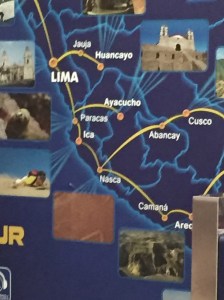
……to view his phenomenon after the many days we had during the group tour of sitting on the bus. Did I really want to spend more time on the bus? Not really. But, I had already paid for the tour, and frugal traveler that I am, I didn’t want to lose the money I had prepaid to Great Nasca Tours for the trip. So, a few days before the end of my Peruvian experience, I went to the lobby of the hotel at 7:30 am and met Annabel, who would drive me to the bus station for my last 2 bus rides of the trip! As usual, I’m glad I went!
First, here’s the bus.
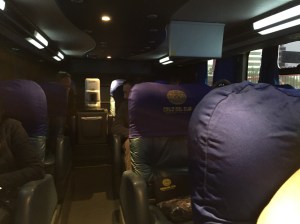
It was like riding in first class on the airplane…..big, cushy seats, my own TV screen for private viewing of current movies, TV shows and videos. And, they even gave me a small lunch and a drink. What’s not to like?!
On the way, I made one small detour in Ica, land of Peruvian wine and Pisco…..and giant sand dunes……


My new friend, Diego, who was my guide in Ica, wondered if I wanted to do some “sand boarding” on the dunes. Apparently, that’s what people do here. They get boards, like one would use for “boogie boarding” in the water, climb to the top of the dunes and slide down. Adventurous as I am, I decided that in the interest of time and my aging body, I would pass on this activity. But, it did look like fun!
Then, we headed out for lunch at a local winery…..

….before doing a tour and some actual wine tasting at “Tacama”, the oldest winery in Peru and, per the guide, the oldest winery in South America.

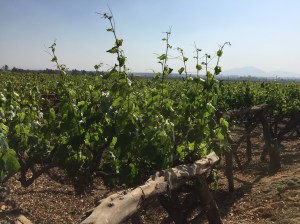
Peru is not known for their wine, although I did have some good Peruvian Cabernet Sauvignon during the course of the trip. Peru’s claim to fame is it’s “Pisco”, which is a kind of wine made with grapes that have gone through a distillation process. It’s the Peruvian equivalent of “Cognac”. I liked it. But, It was quite strong at between 38-45 proof, depending on the type. YIKES! At Tacama, I had the opportunity to try both.
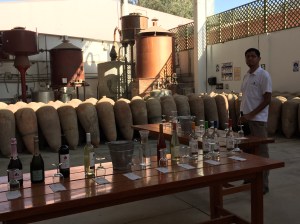
I liked the “Pisco”, but, frankly, I have had better wine. The wine was either bitter or sweet. We also had some whites and a sparkling wine that had been made with Petit Verdot, which was also not my favorite.
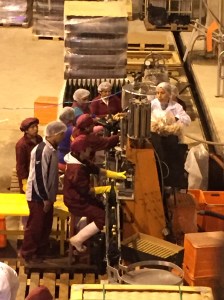
They had odd combinations on the whites like Sauvignon Blanc, Chardonnay and Roussanne together in one blend….very strange…..and, not very good. On the up side, I did get a very interesting tour that included an informative video explaining the industry in general and the specifics of “Tacama”, how the wines were made, and a walk through the production facility, complete with lighted color coding to point out the white and red production areas.
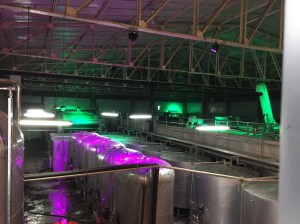
No surprises here. Winemaking is made the same wherever you go.
I parted ways with Diego around 6:00 pm and made my way to Nasca. Here’s where the story really begins.
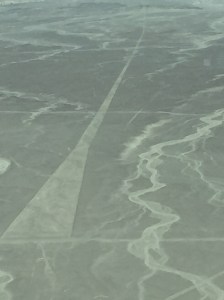
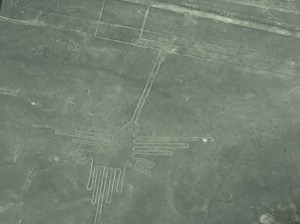
The Nasca Lines are a series of lines and figures that appear on the surface of the desert. Some of the lines are just that….lines, but with some meaning. But, others are geometric figures and representations of people, animals, birds, etc. that had significance in the ancient cultures of Peru. The figures are huge. Some of the figures are miles long and wide. The lines intersect and connect in all sorts of ways through and around the figures. It was interesting to see.
There is a lot of conjecture about how these figures got there. Some people believe that aliens came from outer space and created these designs. I heard this version quite a few times. Really?! I don’t think so….and, neither do the experts who have studied these figures. The most likely explanation is that the Nasca people did this in an effort to honor and please the gods of water.
Nasca is a desert climate and water is now, and was likely, in ancient times, a real problem. The water that was available either came from the sky or the ocean in the way of natural underground wells. There wasn’t much coming from either source. The people living in the desert needed water to be able to grow crops and to drink. So, of course, in their superstitious minds, they thought….we’ll just build some icons to the gods and, if we are good, they will give us the water we need. Silly, but this is how these ancient cultures thought. So, they furiously worked to create these figures and inserted a few temples here and there where they could leave offerings to the gods and worship them.
There is still much debate on the significance of the actual figures that were represented. But, most people agree with Maria Reiche, a German mathmetician, who dedicated her life to uncovering and deciphering these lines and figures. She deduced that many of the figures were based on the constellations that the people could view in the sky at night. She also concluded that the lines and geometric figures were likely related to the direction and location of the water and the position of the sun in the summer and winter solstices. Maria found in her many calculations that many of the lines point directly to the position of the sun in these times of the year. It’s quite fascinating.
It all boils down to a group of people trying to stay alive in a difficult climate and living condition by creating a series of icons to honor and please a group of gods that they believed could help them. Talk about living on the edge!
The lines and figures were created basically by clearing rubble from the desert floor. Again, I am in absolute awe of the diligence of these people to create something like this. The sand underneath the rubble is lighter than the rubble, so when the rubble is cleared, it looks as if someone took a chisel and etched the lines on the surface of the desert. The lines and figures can’t be seen from the ground, only from the air. I also read that they could be seen from the surrounding mountains, but one needs to get high enough to be able to look down on them.
Most people view these lines from the air in a small plane, which is what I did. This was quite an adventure. I read many of the reviews of this experience on Trip Advisor before I attempted this. A lot of them said that they got on the small plane and got motion sickness. They liked it, but warned readers not to eat before getting in then small plane and to be prepared to throw up. Hmmmmm…….I also enlisted some thoughts from a Lantam Airline pilot I met in a restaurant in Lima about what this experience might be like. The pilot, who was French, gave me the pouty French lip stare when I told him I was going to do this. He said,
“Don’t take the 4-seater plane. They have others that seat 10-15. Take one of those. And, by the way, there have been lots of accidents reported in the last few years.”
OK. Good to know…..
Oscar, my Nasca guide, also told me not to eat before I go and to be ready to throw up.
So, after all of this helpful information, you can imagine my anxiety….and my surprise when I got in the air and realized that I wasn’t going to get sick, but was going to get an amazing experience! I loved it!

There were 2 pilots on board that guided the plane and pointed out the figures.
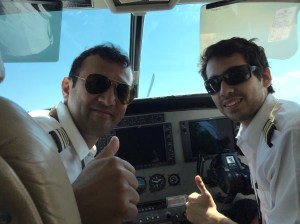
It was fascinating. From our position in the air, the figures looked like small drawings. I was able to see all of them and get some great pictures of a few of them with my iPhone camera.


In the evening, I attended a presentation in a small planetarium behind the hotel where I was staying that was set up in honor of Maria Reiche. As it turns out, she lived in the hotel for free until the end of her life. She had dedicated her life to restoring the lines and had no money even for a living space. The owners of the hotel were more than happy to give her room and board in exchange for having preserved this part of the history of Peru. The presentation gave a little more information about the lines, their discovery and the theories behind them. After the lecture, we went outside with the speaker and used his telescope to view some of the stars and constellations that were represented in the lines. It was very enlightening and a great way to end my time in Peru!
So, now I have come to the end of the lines……all of them…..the people lines and the story lines…..I have gotten an amazing view of a culture and land that is very different from mine. And, the stories…..well……. they have been amazing!
I’m ready now to get back home and back into my “normal” routine. But, it won’t be long before I am ready to line up again for another adventure…..and a few more stories!
Until next time……
 Travel With Betsy
September 30, 2016 at 3:07 pm |
This was my favorite part of your trip!! Never heard of these lines, so it was very informative & interesting to read about. Can’t believe it’s already been a month!!?? Safe travels home!🇺🇸
September 30, 2016 at 4:35 pm |
Thanks, Sue. Flying back on 10/1. Will be in touch when I return!